Fun Facts! About "Tommy" on its 50th Anniversary
This is not any kind of review.

Ken Russell's Tommy was being shown in IMAX this week and I went off to the suburbs with some girlfriends to see it, because, you know, why not.
If you have never seen the Tommy movie, this will not make any sense to you at all whatsoever. This is not any kind of review.
I found out about the IMAX showing via Instagram, an outlet for which there are endless reasons to hate, but I do not leave it. It is my one Meta indulgence because I can see my friends and their pets but also because the algorithm knows me well enough to serve me things like this.
I saw it in the movie theater when it came out. I was 11. I spent the entirety of tonight's screening thinking, How did my mother let me go see this when I was 11? (I originally thought it came out in 1976 but I was off by a year, as though somehow being 12 was a better or drastically different scenario.) I still should not have been allowed to see this movie!
I have no idea how I knew about it. I was not yet the insanely rabid Who fan I would become. But I remember the full-page ad in the New York Times on a Sunday and I asked my mom if I could go see it and she said yes, if you find a friend to go with. So I talked a girlfriend into coming with me on the basis that Elton John was in it.
She spent the entire first part of the film asking me where Elton John was (as though I knew) and then when he did finally appear, she was mad it was not enough Elton John and when we got back to school on Monday she complained to anyone who would listen that I made her go see "a weird movie ." (Not inaccurate!)
I can't work out how long it has been since I have seen this film. I do not own it in any format. I know it would show up on television over the years but I never felt it worked on the small screen, so I never cared to watch it that way. But I definitely went to some midnight screenings of it back in the day, mostly because sometimes that was the best you could do to interface with people you might possibly vibe with.
Let us now refer to THE STORY OF TOMMY by Pete Townshend and Richard Barnes, a book published on Townshend's own Eel Pie Publishing in 1977. (Are you surprised I own this? You are not at all surprised. Holy shit, it is going for over $200 on Amazon.) It is now time to fact check all of the information that decided to emerge from the corners of my brain while watching the film for the first time in decades. That feeling of entire lost volumes emerging in your brain will never not astonish me.
I was at first quite chuffed that I still knew every single line of the score by heart. (I did not sing along, because there were enough bad singers on screen) And before you say you're not surprised I know Tommy by heart, remember that the movie is not just the album on film. Ken Russell asked Townshend for many changes; there are two brand-new songs ("Champagne," where Ann-Margret rolls around in foam and beans and chocolate, and "Mother and Son") and the existing songs are shortened/edited/rearranged. To quote the book, there was "a great deal of rewriting of the original Tommy material. The songs had to fit with Russell's projected timings for each sequence and the words had to explain what was happening--often in a much more literal way than the original had done."
The biggest changes to the story are that Captain Walker gets murdered, not the lover, and they moved the timing of the film up so that it can end in the 70s. There are other lyrical changes as noted above that reflect the action onscreen. I wonder what all of that is like for someone who knew the album well but had never seen this movie before (or heard the soundtrack). I owned the soundtrack before I owned the original, but once I heard the original I almost never ever listened to the soundtrack again, for obvious reasons. But I clearly listened to it enough that I still knew it all, 50 years later.
The literal-ness of the lyric rewrites would bother me a lot once I got to know the original, and I never liked how some of the more transcendent moments on the album were butchered to fit into the story of the film. But I also never got too up in arms because I always believed that Ken Russell was trying to do it justice and it was a separate animal from the existing album. There was nothing about the movie that I felt undermined my love of the record. You could just...not watch the movie and not listen to the soundtrack. (I have other feelings about Quadrophenia on screen which we will inevitably discuss at some point in the future. And I wish I had my notes about my thoughts about the book for the Broadway production of Tommy but it came at a period in my life where I had stopped writing about music.)
"Robert Stigwood rang up and said he'd got Jack Nicholson, and I said, 'Who's Jack Nicholson?' and he said he was one of the biggest stars in America at the moment. So I said, 'Can he sing?' and he said no."
Townshend's reaction was: "I'm not having another fucker in this film who can't sing. Oliver Reed's giving me nightmares as it is."
Oliver Reed was better than I remember, and Jack Nicholson's part was smaller than I remembered.
Ronnie Wood and Kenny Jones played on "Acid Queen," which is of course played by Tina Turner in prime 1970s mode. She is still probably the best performance in the entire film. (Townshend originally wanted TINY TIM for this role. No, I don't get it either.)
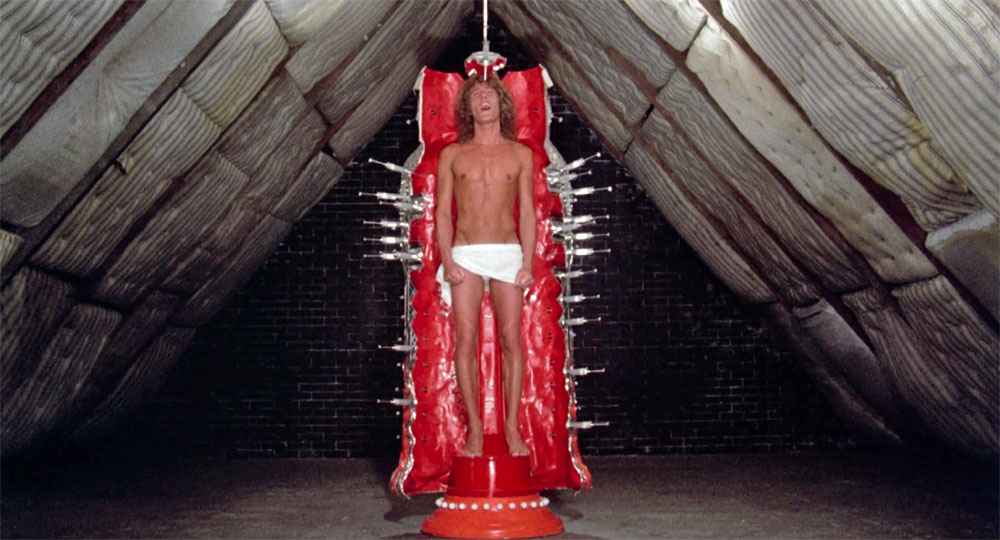
There's a shot during "Acid Queen" that shows a skeleton with snakes crawling through it. The book says: "Originally, the snakes were to be crawling all over Daltrey, but one of the handlers got bit early on, and they decided not to risk it and used the skeleton instead. Then when they counted the snakes afterwards they found they were one short, but the handlers were confident it would die in the cold of the night. Days later they found it, curled up in an inaccessible corner of the machine, still alive--Daltrey had been in and out of the machine several times while it was still there." (Emphasis mine.)
Roger chimes in later that before they settled on snakes, they attempted to substitute stick insects and then they tried butterflies, but all of the insects shit all over him. "You wouldn't think little things like that could make a mess like that, would you?" says Rog.
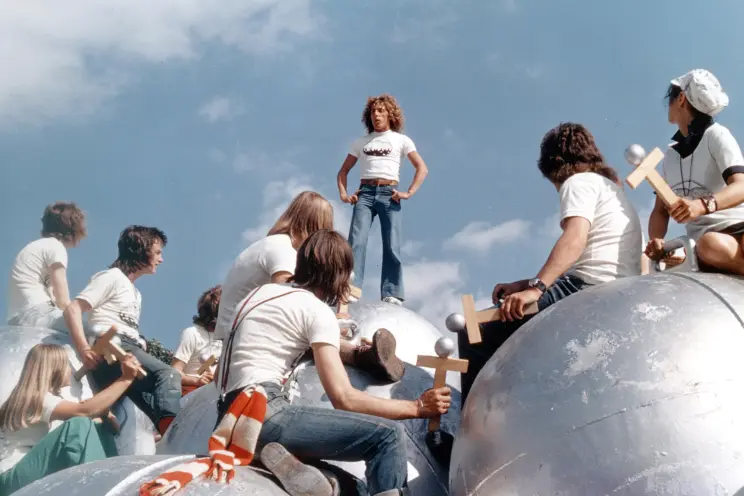
The giant pinballs at Tommy's Holiday Camp were in fact buoys. The props department had to work overtime to get enough silver paint to paint them all. And then they had to keep repainting them because people keep climbing all over them with muddy shoes, which took the silver off.
Ken Russell was the one who hit Ann-Margret over the head with a prop bottle in the final scene, because "Ann-Margret is expensive and accident prone."
The scene where Roger runs through the buoys-as-pinballs was shot THREE TIMES. "The third time a sudden burst of flame caught his hair and singed him a bit. With a sigh of relief that it was the final take, he falls back against a giant pinball and springs away again. It was red-hot and burnt his arm." You can see him holding his arm in the movie.
Daltrey also almost drowned (where he falls through the mirror into the pool, it was a 20 foot drop and he had to do it so many times, because Russell likes as many extra takes as possible, that his back was bruised. They taped a folded towel to his back to try to cushion it but it did not help.).
The scene during "I'm Free" where he's running through the mustard flowers, he had to do THIRTY TIMES and his feet were so blistered he couldn't walk for three days. And finally, that is him actually hang-gliding, and he crash-landed into a patch of thorns and he had to spend the next day having thorns plucked out of his feet.
We're not even talking about him swimming, standing under waterfalls, or climbing up mountains. The only time a stunt double was used was for "a jump from a high tower."
(Completely unrelated: the soundtrack version of "I'm Free" is one of the few Who songs I can play on guitar. There's something about the cadence that was easier for me to manage.)
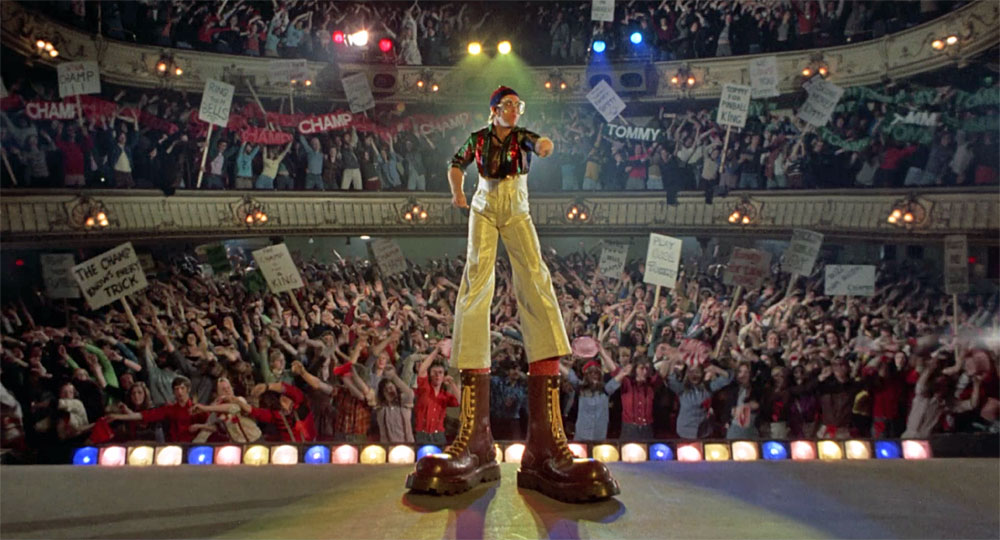
Even though Elton John's band is actually playing the music for "Pinball Wizard," the Who in that scene are actually playing live. This is because Pete "couldn't get into 'prancing around on stage pretending to play with an unplugged guitar.'"
The extras in the theater came from a local college and to say thank you, the Who played a private gig for them later. When Pete breaks his guitar at the end of the song, a piece of the guitar flew through the air and injured one of the extras, who had to be taken to the hospital for stitches. (Pete later gave her the pieces of the broken guitar.) THERE WERE A LOT OF INJURIES MAKING THIS MOVIE!!!
Elton John stood on a box whenever his boots were not in the shot. He had to climb a stepladder to put his boots on, "but once strapped in, he could walk about with them."
The musicians were (at least according to the book!) all drunk in the "Eyesight to the Blind" scene. This is mentioned in the same sentence where it's noted that Clapton's appearance in this film "was all part of his coming out therapy." And the thing he was "coming out" of was heroin addiction. Great job, folks!
(Apparently Clapton also spent one night hammering on Ann-Margret's hotel room door yelling, "I love you, I'm yours.")
Finally, Ann-Margret cut her hand in the "Champagne" scene. "She'd cut her hand and arm on the jagged edge of the TV screen, was rushed to hospital, and had to have 24 stitches. The accident was carefully kept out of the press at the time."
Now that the trivia is out of the way, what I enjoyed the most about seeing it again was being able to see Pete and John and Keith (and Roger, of course, shirtless and looking perfect) playing music or at least executing a reasonable facsimile of performing. They are young and full of energy and, well, alive, in the case of two of them. It's been so long since Roger had long hair.
When I saw the film originally, the entire movie theater went bonkers as soon as Elton came on screen, to the point that they stopped the film and the manager came out and told everyone they had to calm down or they'd end the showing. (If you happen to know Stamford, Connecticut at all in the 70s and 80s, it was at the Ridgeway Theater, which was this gorgeous old art deco theater that would also be the one place that showed Rocky Horror back then. It's a LA Fitness now.)
The other element I vividly remember is how the film was a window into British culture. You got to see elements in situ, like Elton's gigantic bovver boots, the football scarves being waved, the rubble of the bomb sites being present in everyday life, the concept of a holiday camp, the money, and even the locations and the buildings weren't props or shot on a lot or CGI, they were real locations. If you were a fan of British Invasion bands and hadn't yet made it across the pond, it was a small slice of real life context.
The other element that truly stood out – especially after having to watch 30 minutes of boring previews – was how no one in the film, even Ann-Margret, was overly polished. No one had perfect teeth. I still can't believe that Daltrey shot all of the scenes in the air and in the water and literally climbing a fucking mountain. The crowd extras were very, very extra.
On that note, one of my big complaints about seeing music films is that the volume is never adequate. This was not the case for this showing, and whatever remixing was more than adequate. I know what these songs should sound like and despite whatever hearing loss I might have acquired over the years, everything sounded the way it should. Similarly, whatever work they did to the print to make it IMAX-ready didn't try to make the film into something it never was. (Full disclosure: I know absolutely nothing about the technical side of movies so if you have an opinion about this, please drop me a line.)
Townshend was on the nose about cults and false idols back then and that theme holds up even more in 2026. His commentary about people searching for "faith in something bigger" was accurate then and is even more accurate now. As much as I wanted these two hours to be an escape, there was no way to not think about that aspect of it, precisely because he'd captured it so well.
When the film was over, everyone waited for the credits to roll, which surprised me a little bit. But I think that was because everyone who came to see this movie on a Wednesday night at 6:30pm was there because they had some kind of fond feelings about it and so everyone was there for the same reason. You used to be able to say that about concerts but you definitely cannot do that any more (maybe hardcore shows you can).
No one was here because it was a place they wanted to be seen or because they wanted to post about it on social media or because it was going to add to their street cred. And if anyone talked through the movie, the music was loud enough that I couldn't hear them. There were plenty of exclamations of surprise or delight and plenty of laughs at the things that were absurd.
Finally, I adore the absurdity and have so much respect and admiration for the complete and total audacity of everyone involved getting this movie made. I'll likely never see it again unless I have to write about it, but I'm so glad this particular piece of art exists.
 Caryn Rose